

Brush and search locations
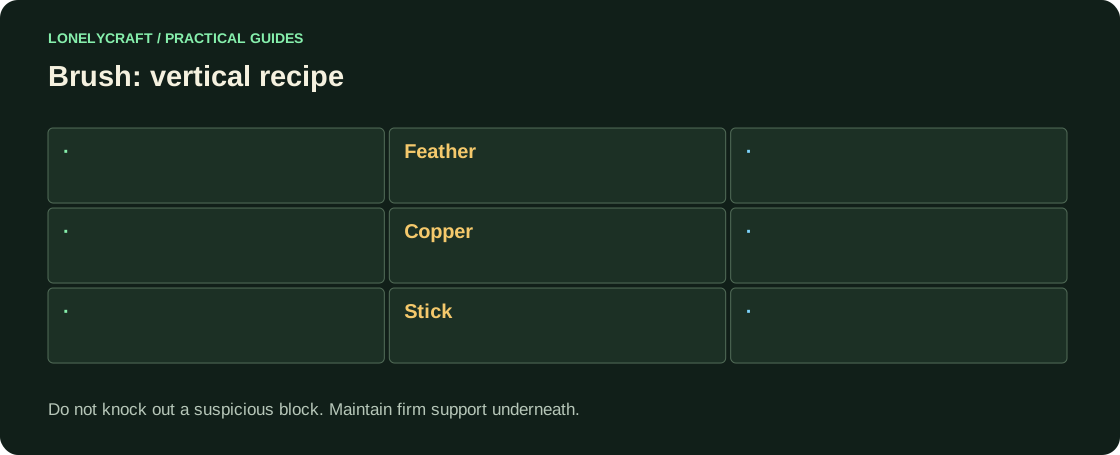
Place a feather, a copper ingot and a stick in the vertical column of the crafting table from top to bottom. You will get a brush. Suspicious blocks differ in texture: ordinary sand or gravel does not have archaeological content. Reference: Minecraft: brush.
Look for desert wells and pyramids, ocean ruins and trail ruins. Loot tables vary: a shard found in one place does not promise the same set in another.
Dig from above while maintaining support
Remove normal material from the area without disturbing the block underneath the suspicious find. A loose suspicious block breaks when dropped. If there is a cavity at the bottom, support it from the side until the adjacent blocks are removed.
Move the brush and hold application until complete. After clearing, the suspicious block becomes normal, and the item drops out nearby. Underwater, first organize air: an attempt interrupted for the sake of inhalation is better than drowning with prey. Silk here does not replace on-site work.
Prepare your breathing reserve and underwater exit according to the instructions: Exploring the ocean: boats, shipwrecks and underwater ruins.
Choose the pattern for each side
The decorated pot is made from four shards and/or bricks in a cross pattern: top, left, right and bottom of the center. The shard defines the side pattern, the brick defines the smooth side. For one pattern, use one desired shard and three bricks.
Before crafting, separate the only copies of the collection. Do not use explosions or mass rapid digging to clear ruins: the lost contents of suspicious blocks cannot be recovered from regular sand.
Disarming traps of other structures is discussed here: Exploring structures: traps, chests and a way back.