
Record the design’s operating conditions
On the sheet, indicate the edition, the exact edition, the dimensions of the module and the player’s place during work. The name "farm 1.21" is not enough: observer, piston, spawn and loading world differ between Java, Bedrock and server settings. Reference: Microsoft: Java and Bedrock differences.
Leave the stand open. First, test the mechanism manually: for example, place a sugar cane at the height of the sensor and see which block knocks down the piston. Check the growth of the plant with a separate wait - manual completion only confirms the mechanical chain.
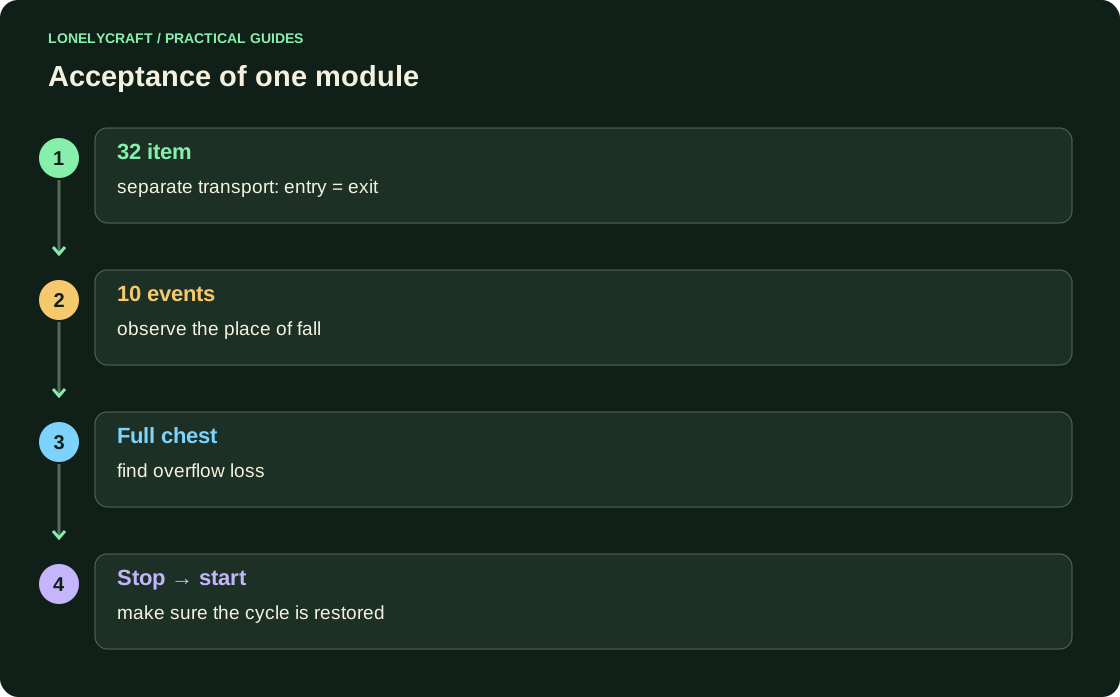
Three counting tests
Transport: place 32 stones at the entrance, wait for them to pass and confirm 32 at the exit, zero at intermediate nodes. Production: Run 10 identical manual events and record where the loot lands. Overall run: Compare input and output in a fixed time.
| Sample | What it detects |
|---|---|
| 32 item via transport | Spouts, nutrition and leaks |
| 10 production events | Getting stuck or falling off the edge |
| Full Exit Chest | Overflow Safety |
For maintenance, provide a controlled stop: Building a farm shutoff switch in Minecraft.
Test a full output and a restart
Fill the final chest with cheap material. See where the next loot goes: stays in the buffer, lies in the world, or gets destroyed. The floor drop disappears, so overflow requires production shutdown or additional storage.
Turn off farm in the middle of the cycle, remove the interference and turn it on again. Then check after leaving and returning to the area. Only after these tests copy the module and cover it with walls: the cladding can block the water, expose the spawn, or create an extra spawn area.
A working module with observer is disassembled here: A sugar cane farm: from a manual row to one automatic module.