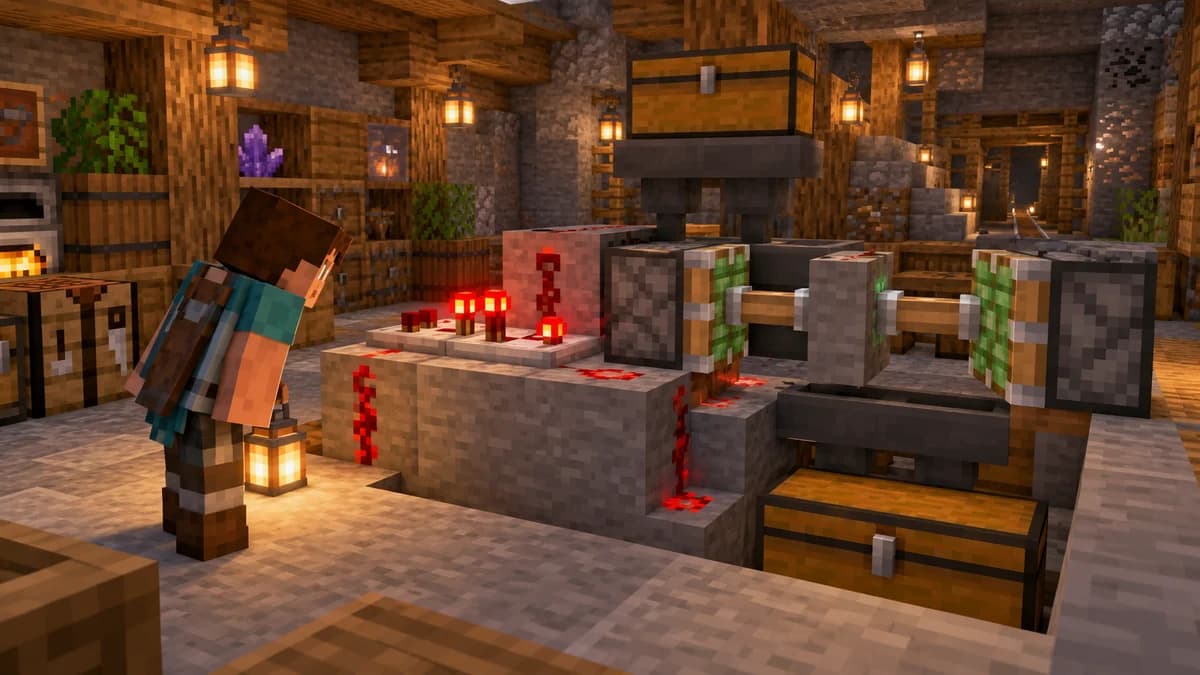
Place it right side up
Two small rear racks face the container, one front one faces the exit. To read a chest, place the device close behind its wall with the exit outward and pull the dust away from it. Reference: Minecraft: comparator.
Recipe: bottom row of 3 stones, quartz in the center, 3 redstone torch on top center and sides of middle row. You need a regular stone, not cobblestone. The front flame is extinguished in comparison mode and lit in subtraction mode.
Test signal thresholds with a hopper
Place the hopper with its spout in a solid block so that it does not unload. Read her comparator; make a long straight line of dust at the exit. For regular items with a stack of 64 the values will be:
- Change the quantity 1 → 22 → 23 and observe the second level boundary.
- In Java, the dust strength can be viewed in the hover block data at F3; in both editions the length of the luminous line is visible.
| Stones in five slots | Strength |
|---|---|
| 0 | 0 |
| 1–22 | 1 |
| 23–45 | 2 |
| 46–68 | 3 |
| 320 | 15 |
Use the numbers 41+4 only with control samples: Testing an item sorter before putting it into service.
Comparison and subtraction
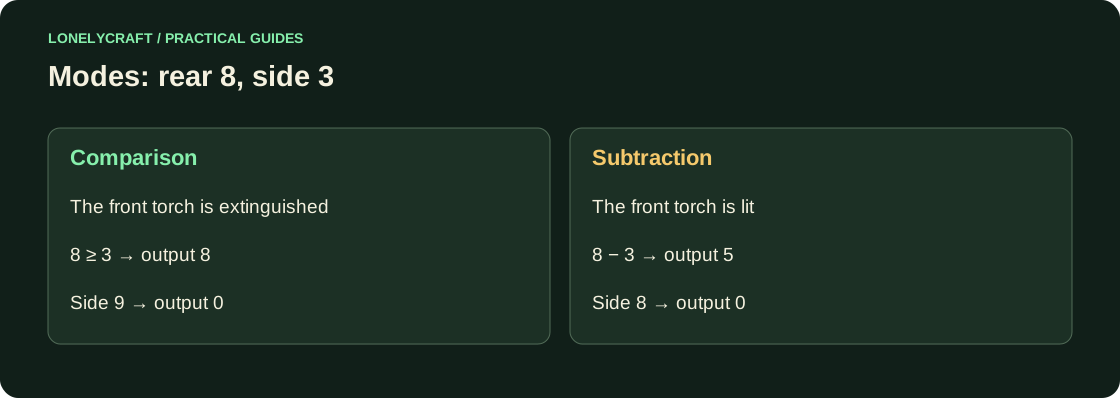
Without the glow of the front torch, the rear signal passes without amplification if it is not less than the side one; the larger side one zeroes the output. When the front torch is turned on, the strongest side torch is subtracted from the rear torch.
Example: rear 8, side 3 - comparison gives 8, subtraction 5. With a sideways 8 comparison still gives 8, subtraction 0. For the “container is not empty” signal, any output is sufficient; for “almost full” you need a calculated threshold, and not one lamp immediately behind the device.
Direction, gain and delays are discussed separately: Repeaters: direction, delay and long signal lines.