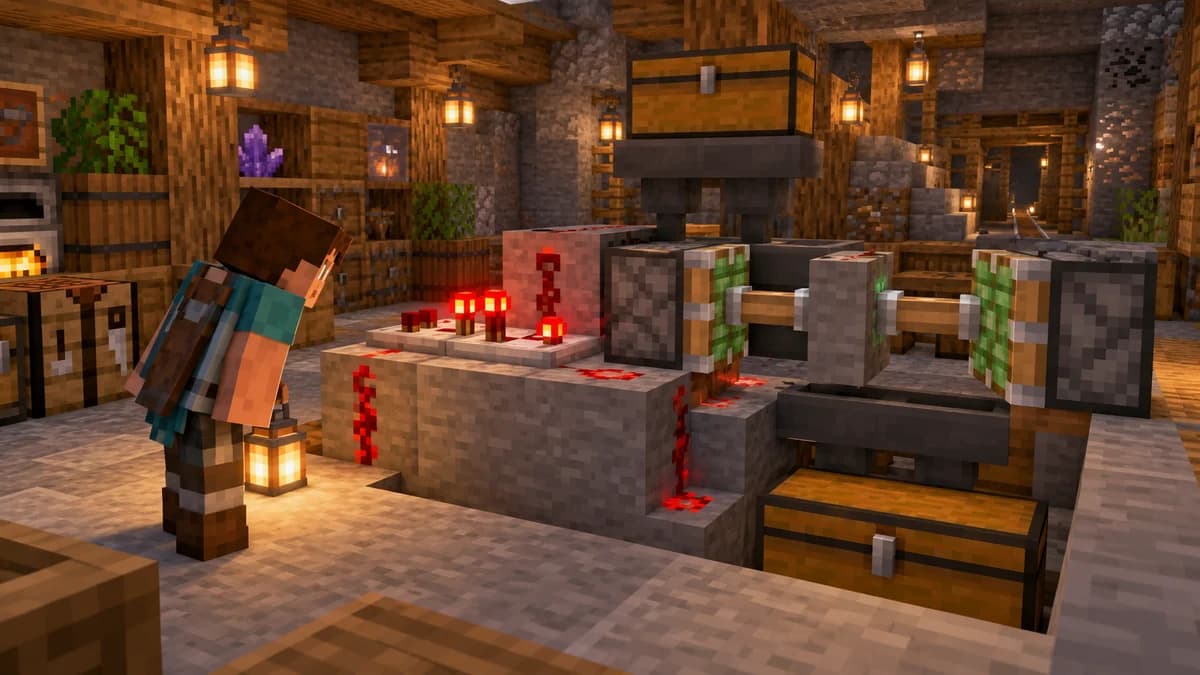
A seven-cell test circuit
On a flat, solid base, assemble a straight row: lever → 5 dust → lamp. Place dust with the use button, rather than by throwing the item out of your inventory. Turn the lever twice: the lamp should turn on and off. Reference: Minecraft: redstone dust.
The lever is made from a stick over cobblestone. A redstone lamp is made from glowstone and 4 dust in a cross pattern. To mine redstone ore you need an iron pickaxe or better.
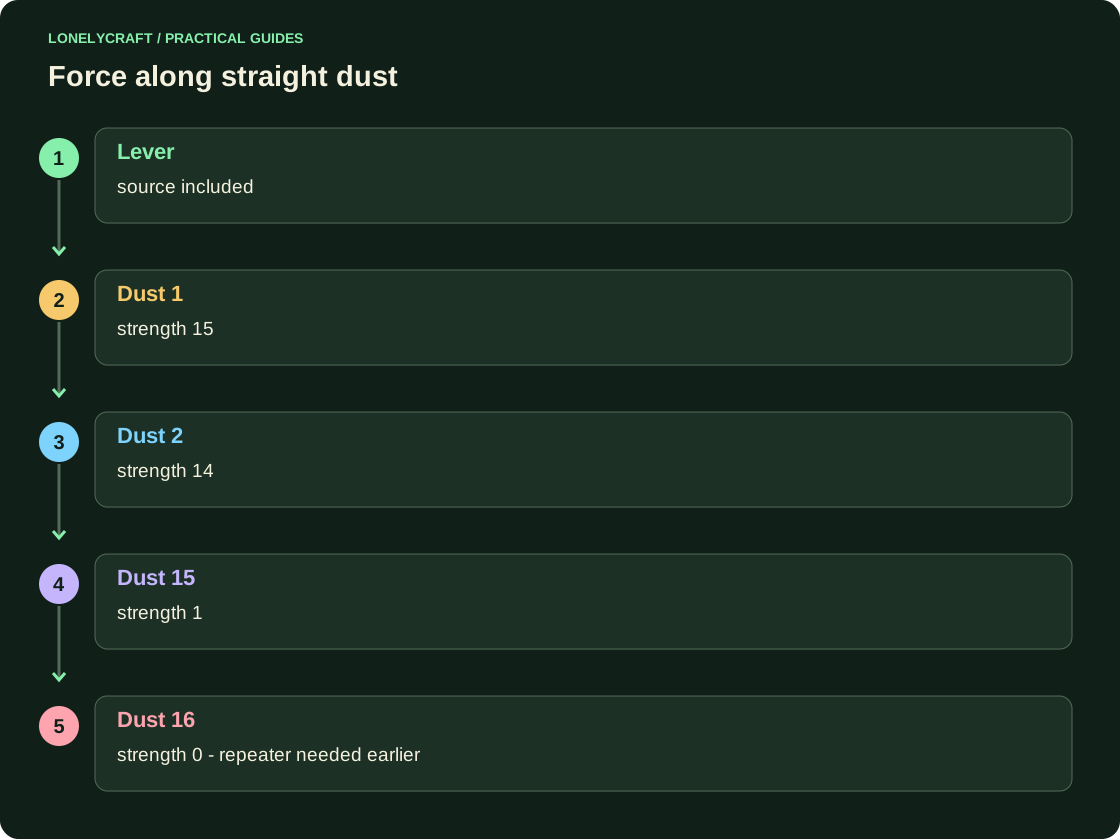
What does the power 15 mean?
A normal strong source gives the first dust the strength of 15, then 14, 13 and so on until 1 on the fifteenth. The sixteenth continuous dust no longer transmits an active signal. repeater is placed after the still active part to restore strength.
In Java, F3 shows the power state of induced dust; in both editions you can see the border of the glow. Don't check the long line just by the lamp at the end: start at the source and work your way to the first dark square.
Direction, gain and delays are discussed separately: Repeaters: direction, delay and long signal lines.
Constant signal and pulse
The lever retains its state until the next press. The button gives a temporary signal, observer - a very short event. If the lamp blinks, first find out the source type; it's not necessarily a bad connection.
When lifting, leave a clear space above the bottom area of dust so that the connection along the step is not blocked by the block. Check the flat line first, then add one rise and branch. Java and Bedrock handle some complex circuits differently, so a basic bench is more useful than randomly rearranging dozens of parts.
First check the direction and pulse of the sensor: Minecraft observers: facing direction and pulses.