
Notes that survive losing the map
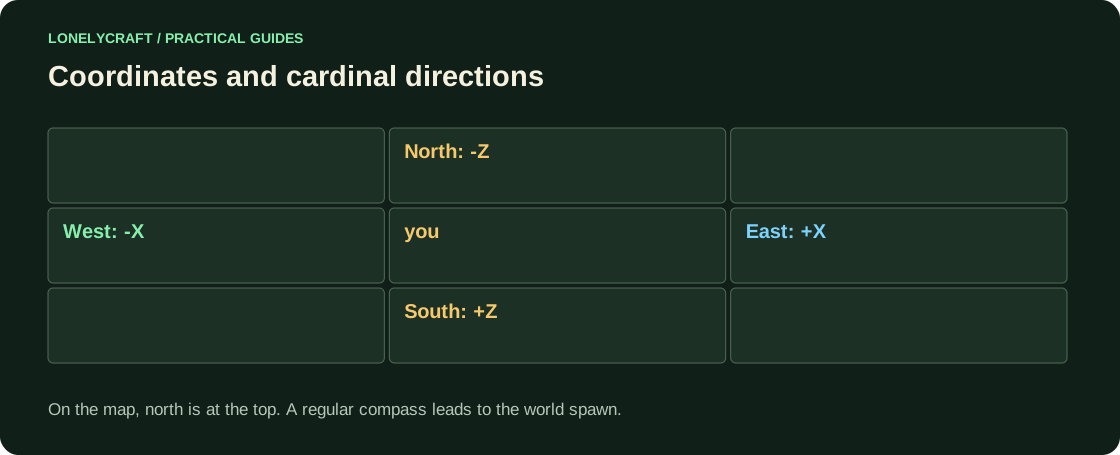
Format: "House - Overworld, X=240, Y=72, Z=-360". To the east X increases, to the west it decreases; to the south Z increases, to the north it decreases. Y is needed for multi-level caves and roads. Reference: Minecraft: Cartographer's Table.
Make a noticeable pillar or tower near the house, and signs with the direction and distance at the forks. For the mine, choose one side of the torches as you go deeper. This is your own agreement, so explain it to other players.
A locator map at the right scale
In Java, a blank map is made from a compass and 8 papers. In Bedrock, a map without a locator and a map with a locator are different: you need a compass for the pointer. Cartographer's table: 2 paper over a square of 4 boards.
The initial map covers 128×128 blocks. Paper in the mapper's table doubles the coverage on each side, to 2048×2048 at 4 level. For the base road, levels 0–1 are convenient; for the ocean - 2–3. There is no reverse zoom of an already enlarged map.
For a general atlas, a separate grid of adjacent maps is needed: Building a wall map of your world.
North of the map does not rotate with the player
The top of the map is north (-Z), east is on the right (+X). If the house is higher and to the left of the pointer, decrease X and Z. Before moving, compare the current coordinates with the recorded ones, and not just the camera direction.
Make a copy of the work card across the table with the blank card. It is useful for the second player and for the wall. The glass panel captures the image; use it for a saved diagram, and not for a map that you are still going to open.
If world allows searching for command, use your edition's syntax: Locate a structure or biome and plan your route.