Assign a role to the material
For the first option, take birch boards for the wall, debarked dark oak for the frame and glass for the window. For the second, replace the birch boards with spruce ones, leaving everything else. These are author’s combinations for comparing contrast, not a mandatory biome palette.
If rare dark oak is in short supply, replace the frame with available wood in both specimens. Don't change the wall, frame and roof all at once: otherwise it will be difficult to understand what exactly improved the look.
Build the full 35-cell samples
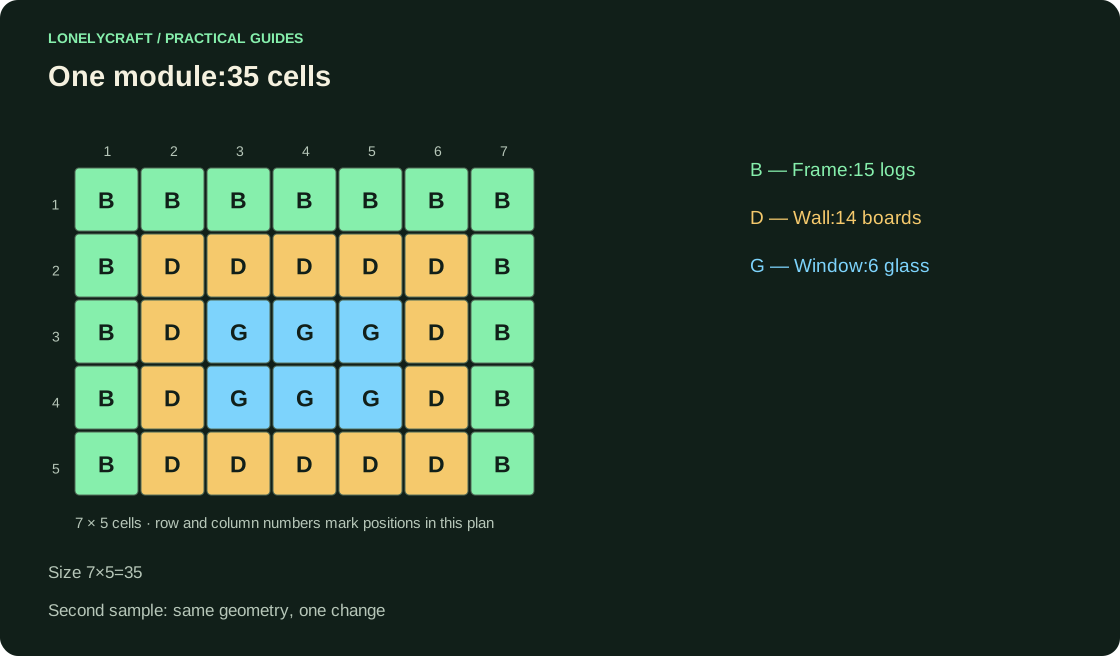
Module coordinates: x=0…6,y=0…4. The two outer pillars x=0,6 each have 5 logs, the top lintel x=1…5,y=4 also has 5. Window x=2…4,y=1…2 occupies 6 cells. Fill all other 14 cells with boards.
Total 15 logs +14 boards +6 glass =35. The frame occupies approximately 43%, the wall 40%, glass 17%. These shares describe only a sample, not a universal rule for the whole house. The overhang from 7 steps and clerestory can be added later, separate from this bill.
Choose an option using the same test
Inspect both modules with 12 blocks in regular textures. First check if the frame and the wall are different, then if the window is visible. In the evening, repeat with the same light source for each sample.
Leave the winning module near the construction site and sign the composition. Add texture in selected places - the bottom of the plinth, a wet corner or damage, and not a random cell every other. To calculate the entire facade, first repeat the entire module, then separately calculate the corners and the door.
The form remains readable until small details are added. Transfer material to house 9×11.
The color of lighting can change the apparent contrast of materials. Check the palette in the evening light.