
Five projects and their completion criteria
| Project | First volume | When ready |
|---|---|---|
| Road to farm | One route from door to entrance | You can walk at night without losing direction |
| Clear warehouse | Six signed categories | A friend finds an item without your prompting |
| Biome Expedition | One new biome and four samples | Finds at home, return route recorded |
| Exact stop after jump | Five platforms above the safety floor | Three passes in a row without falling |
| Quarter for the company | One street and facade of each participant | The road level and the width of the entrances converge |
Project for one evening: road
First, walk the path and mark dangerous edges, water and forks. Make minimal passage and signage; cover and decorations will be added after trial return. Don't start with lanterns all over the map until you have a route decided.
Ask a friend to go from base to farm without voice prompts. Write down where he took the wrong turn. Correcting one such turn is more useful than ten more ornamental bushes.
Make the road understandable to a person who did not build it. Routes and landmarks.
Three sessions for a storage room
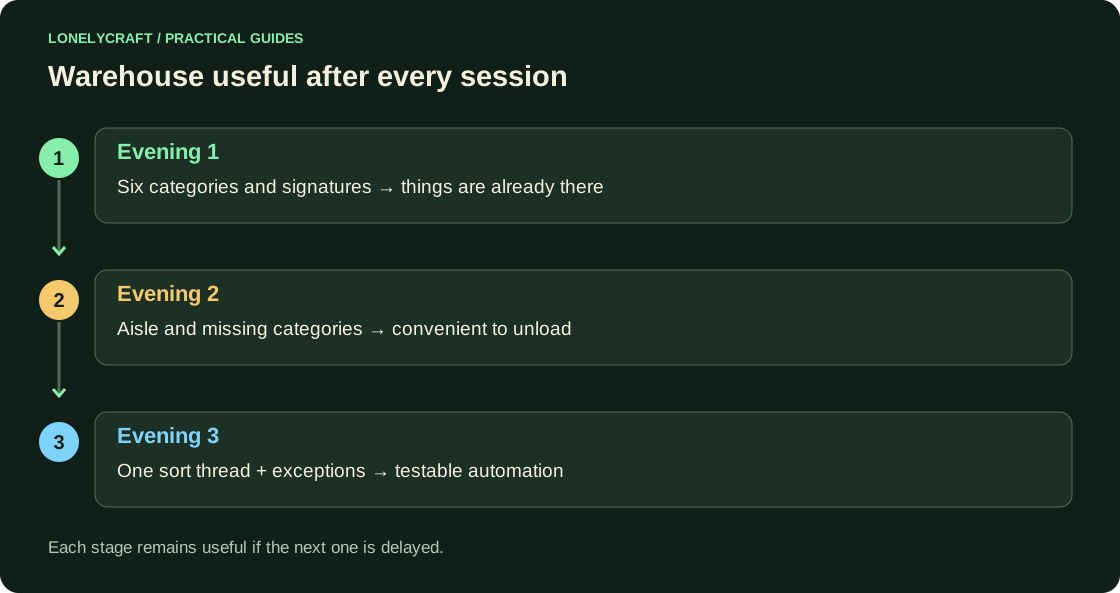
In the first session, lay out the main categories and label six chests. In the second, add the missing categories and a convenient passage. In the third, automate only the repetitive flow that is already understood manually.
Test sorting with a small known lot and a single unsuitable item. A large, beautiful body does not compensate for the loss of materials. While the system is under construction, manual entry and the exception chest should remain accessible.
Separate the layout and sorting mechanism. Warehouse plan.
Expedition or skill instead of construction
For the expedition, choose one goal and return condition: for example, four local samples, the remaining half of the food, or filling two rows with finds. Write down the base and forks. You don't have to complete the entire collection in one go.
For jumping, place five 2×2 pads on the same level with one empty block between the edges, above a flat, safe floor. Go through three times, then reduce two pads to 1×1. This checks for stopping rather than the risk of losing gear.
At the end, leave one task with a number: “place eight supports”, “sign four chests”. If the project is no longer interesting, reduce it to a useful completed piece and choose another goal.